M. Whitfield Ltd., a chain of community pharmacies in Co. Durham and Cleveland, began distributing stock to its own pharmacies from its Lynn Street, Hartlepool branch in around 1949.
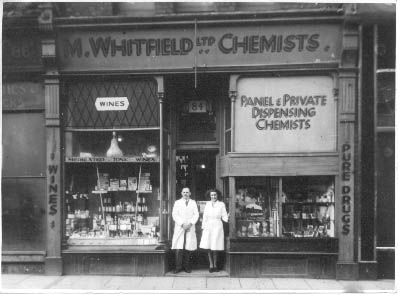
Lynn Street, Hartlepool, at some time between 1946 and 1948, showing the pharmacist Mr. John
Grundy (a Director of M. Whitfield Ltd) with Miss Susan Harker
WEST HARTLEPOOL DRUG CO LTD
In 1950, the West Hartlepool Drug Company Ltd. was incorporated at Companies House, and the wholesale distribution was relocated to premises situated on the corner of Southgate and Victoria Street on Hartlepool Headland opposite St. Hilda's Church.
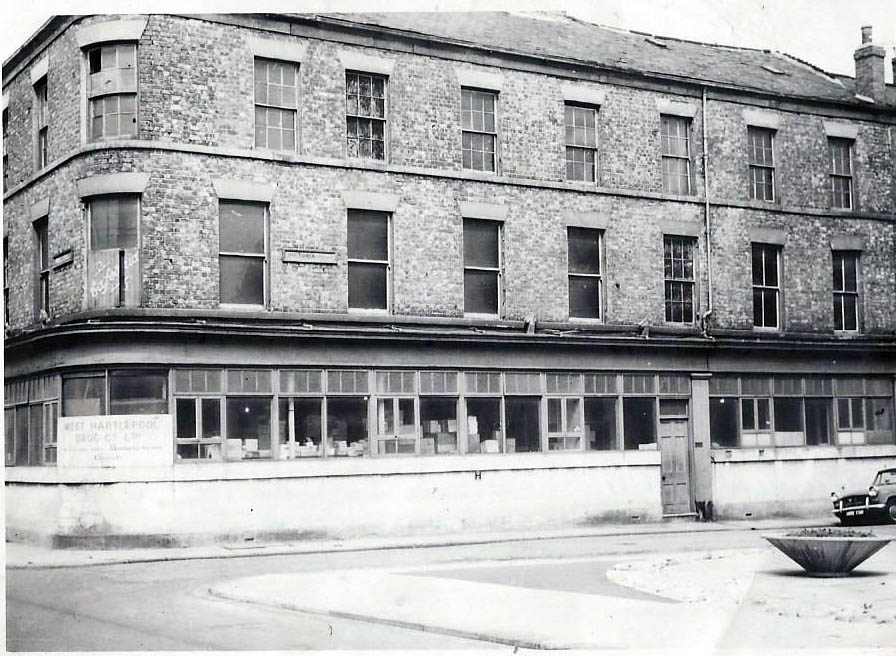
West Hartlepool Drug Co. Ltd in Victoria Street, Southgate, Hartlepool in August 1964
At the time of this photograph, West Hartlepool Drug Company had only 16 customers and was being managed by Mr. Robert W. Johnson, the son-in-law of the founder of M. Whitfield Ltd. The warehouse was open for four mornings per week (Monday, Tuesday, Thursday and Friday), supplying the eight branches of M. Whitfield Ltd, four of G. Whitfield Ltd., one of R. Whitfield Ltd., and three other customers. The Southgate property was sold to property developers who built a housing estate on the site after its demolition in 1981. The wholesale business was relocated to the former Pit Baths at Trimdon Station in 1979 and renamed Durham Pharmaceuticals Ltd.
History of the premises
The building that was occupied by West Hartlepool Drug Company had a fascinating history, involving one of the most important men in the history of Hartlepool, Sir William Gray, who for a short time lived in the premises.
William Gray was born near Blyth, Northumberland in 1823. He was an apprentice in his father's successful drapery business in Newcastle-upon-Tyne, before spending some time in a drapery shop in London where he realised that the stock was much more fashionable than was available in the North east. At the age of 20 he decided to start his own drapery business using stock he bought from the connections he had made in London. The shop he purchased was on Hartlepool’s Headland in Southgate (part of High Street at that time) which formed the left-most part of the building in the photograph above.
In 1849 he married Dorothy Hall and for a brief time lived above the shop.
In 1862 he was elected Mayor of Hartlepool, and became heavily involved in shipbuilding, forming a company William Gray & Co. which would later become one of the largest shipbuilders in the world. He sold his drapery business in 1863 to four men, Callender, Richardson, Peverell and Kilvington, three of whom had worked in the shop. The new enterprise was named Gray, Peverell & Co. Ltd., and Gray continued to work for the company as a consultant and Chairman. The business eventually occupied 49, 51 and 55 High Street and most of Victoria Street, so that the entirety of the frontage seen in the 1964 image above formed part of the shopfront. As well as retail and wholesale drapery and outfitting, the shop also stocked a wide range of furniture.
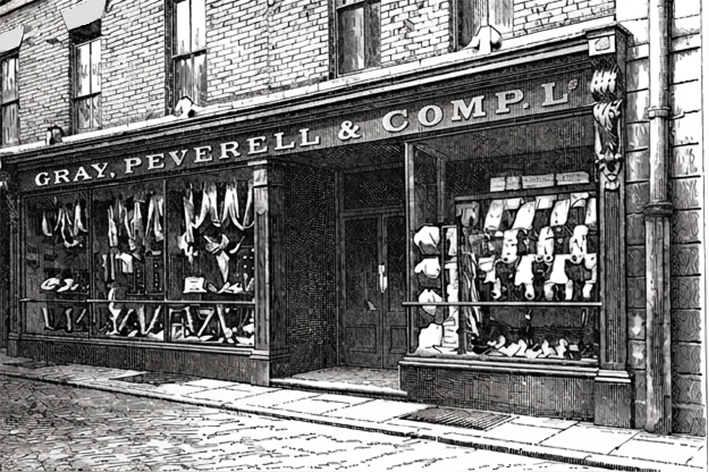
The Victoria Street facade of the Gray Peverell & Co. premises ca. 1890 (the same facade as seen in the 1964 picture above).
In 1887-88 William Gray became the first Mayor of West Hartlepool – the only man to be Mayor of both towns – and in 1890 he was knighted by Queen Victoria for his services to the two towns and industry.
He died in 1898, leaving a fortune worth more than £93million in today’s terms.
In 1902 Gray, Peverell & Co. Ltd. opened another store in Victoria Road, West Hartlepool which was renamed Binns when the company was taken over by the Sunderland-based H. Binns Son & Co Ltd chain in 1926.
The Southgate building became a cafe, and the sign 'Cafeteria' can faintly be seen on the first floor corner window on the left. At the time of its demolition in 1981, painted signs were still visible on the first floor, asking customers to return their crockery to the corner where there was a rope operated dumb waiter running through all three floors. Mr. John Grundy's sons John and Peter used to ride the dumb waiter when they were children. The dark green Triumph Herald in the bottom right of the picture was owned by Mrs. Mary Ann Grundy, the wife of John Grundy.
DURHAM PHARMACEUTICALS LTD
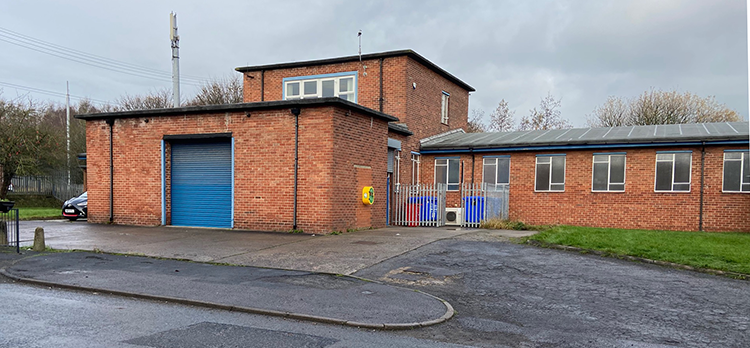
Durham Pharmaceuticals Ltd in Trimdon Station in 2022
After the relocation of West Hartlepool Drug Co. to the old Pit Head Baths in Trimdon Station in 1979 and changing its name to Durham Pharmaceuticals Ltd, the business grew rapidly until by 2017 it had become a major regional pharmaceutical wholesaler with four vans, over 340 customers, and employing 22 staff.
History of the premises
The building now occupied by Durham Pharmaceuticals Ltd was originally the Pit Head Baths for Deaf Hill Colliery
(Deaf Hill is also known as Trimdon Station).
The first Deaf Hill Colliery pit was sunk in 1877 by Trimdon Coal Co., with the third pit being sunk in 1891. In 1947 the colliery was nationalised and operated by the National Coal Board (NCB).
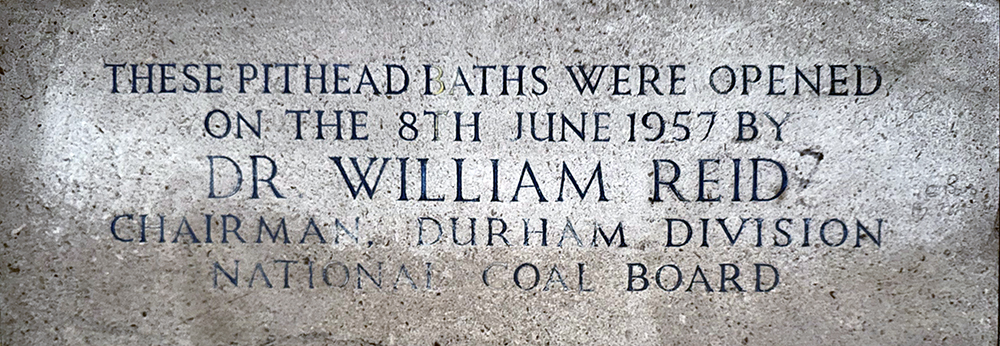
It was not until 8th June 1957 that the Pit Head Baths were opened, meaning that for 80 years miners had to return from their shifts to their homes to bathe. The baths were officially opened by Dr. William Reid, the chairman of the Durham division of the NCB, and the commemorative plaque can still be seen at the entrance of Durham Pharmaceuticals Ltd. (below).
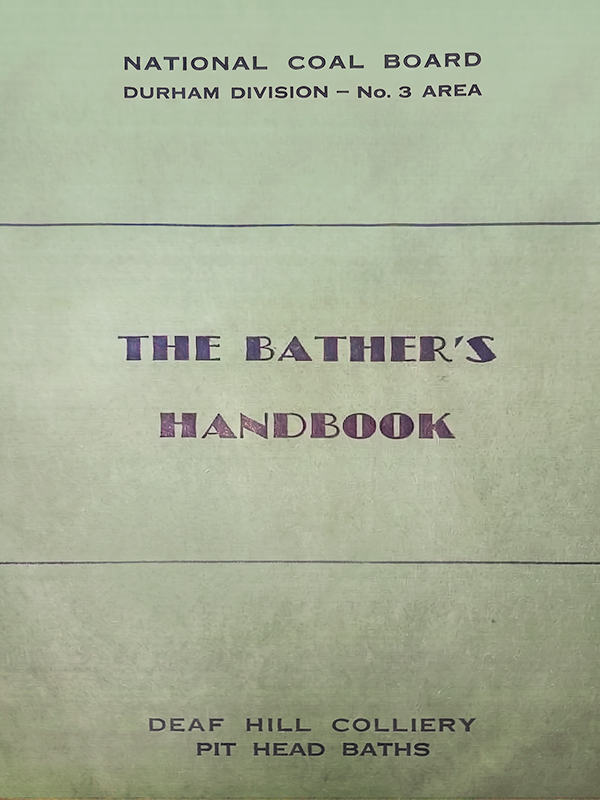
All miners were given a copy of "The Bather's Handbook" before starting work, so they could learn the do's and don'ts of using the facilities. Clicking on the image below will allow you to read the whole handbook in a separate window.